Wednesday, December 18, 2013

How I Spent My Summer Vacation - Elliott Murphy Live at the Bottom Line, New York City, 1992

I've been to New York City.

In and of itself, that's no great pronouncement, literally MILLIONS of people have been to New York City.  (And, of course, millions of people LIVE in New York City.)

But when I was a child, growing up in Columbus, Ohio, in the 1950's and 60's and watching endless hours of television shows about educated, cultured, erudite (not to mention rich) people living in New York City, I couldn't imagine ever actually visiting there.  I realize this says more about my lack of imagination as a child of the West Side of Columbus than it does anything else, but there you go.  The idea that I could share a sidewalk or a Sardi's with the likes of Danny Thomas, Barbra Streisand, Mary Martin, Dick Van Dyke, Ed Sullivan, etc. was just a non-starter, ya know?  (And once I read Hubert Selby Jr.'s Last Exit To Brooklyn as a teenager in 1968 I was scared shitless to step foot in N.Y.C.)

Anyway, I've now been to New York City any number of times: on vacations, on my 2001 honeymoon at The Plaza, on rock & roll missions with Watershed and Hamell On Trial.  (At one point in 2005 when Hamell was formulating & finalizing what would become his acclaimed The Terrorism Of Everyday Life one-man show, his management company was flying me back & forth from Columbus to N.Y.C. once a month just to run lights and stage-manage the work-in-progress run-throughs at a tony Manhattan comedy club.  I felt like a rock & roll star, except there was no dope, hookers or Chinese food.) 

In all of those visits, though, right up through last summer on a Watershed tour, I have never been able to shake the feeling of being a fish-out-of-water-hayseed Midwest boy staring up at the tall buildings in the Big City.  The visit detailed below - penned for the late-lamented Elliott Murphy Newsletter that manager-extraordinaire Charlie Hunter published in the 1990's - was no different.

(readers, employ your zoom feature.......or is it your bang/zoom feature?)


© 2013 Ricki C.

Murphy piece © 1992 Ricki C.

Friday, December 13, 2013

Scruffy The Cat "Tiger Tiger" (Bonus Video Friday)

Hi folks, it's been awhile since I've run Bonus Video Friday, and this will be the only one in December (maybe).  I wanted to run it because it's a great, great song and because it's only ever had 259 views on YouTube, which borders on the criminal.  I used to see Scruffy The Cat on my 1980's Boston excursions (see blog entry Flying To Boston To See The Rock & Roll, January 13th, 2012) and they were always superiorly clever AND rocking.

(By the way, if anybody's interested in Christmas rock & roll videos, my favorites ran in Growing Old With Rock & Roll last December 1st, 4th, 11th, 13th, 19th, and 24th.  Check 'em out.)


inspirational verse; "Sometimes you treat me like apple pie /
Sometimes I think you wanna see me cry / I just don't know what's the matter with you /
I wish I knew, I wish I knew, I wish I knew" - Charlie Chesterman, 1986   

(And exactly how many rock & roll songs pack as many hooks AND a William Blake
reference into 2 minutes and 31 seconds as this snappy little number?) 


© 2013 Ricki C.


Monday, December 9, 2013

The Ballad Of Willie Phoenix, part two - The A&M Band, 1981-1982

After The Buttons split up in 1980, Willie turned his attentions to a solo career.  Romantic Noise and The Buttons had been pure power-pop creations: four-piece guitars & drums bands stressing harmonies and three-minute pop confections of the highest order.  Willie's next band was formed with the idea of extensively widening that rock & roll palette.

Contemporaneous articles of the time - from the Ohio State Lantern and The Monthly Planet (the completely dreck-ridden, unlamented successor to Focus as Columbus' music weekly) - tell me the name of that band was, alternately, The Stray Revival or Willie & The Passions.  I never heard the band called by either one of those names.  Rockers around town routinely called it "Willie's Big Band" and later, after they were signed, "The A&M Band."  Stray Revival or Passions?  I don't think so, though both are cool names.

That band was comprised of Willie on rhythm guitar & lead vocals, Greg Glasgow - Willie's right-hand man, held over from the earlier bands - on bass & backing vocals, Rob Brumfiel on lead guitar, Mel McGary on keyboards and Gary "The Captain" Strauss, a strapping 300-pound drum-basher.  There were always two or three female back-up singers (who were dubbed "The Willie-ettes" in tribute to Ray Charles' girl singers - beginning with CiCi Hank and Tracy LaTour - but I swear there were different girls every few months.  (If my memory serves, even Donna Mogavero - later and still a popular Columbus folkie singer/songwriter around town - was a Willie-ette at one time.)

The sound of The Big Band was solid heartland rock & roll.  Willie's songs got longer, more involved, much expanded from his previous power-pop stylings.  It wasn't prog, by any standard, but man did some of those songs have a lot of sections.  Think Bob Seger or John Cougar (pre-Mellencamp), maybe with a little Bruce Springsteen thrown into the mix.  (I remember thinking one night I was glad they didn't have a saxophone player or it all might have been a little bit TOO obvious.)

Again, Willie scrapped the entire previous bands' repertoire and started over from scratch.  A couple of songs - "Mary" and "New York Is Burning" - existed in Willie's pre-power-pop acoustic sets and were revived in revved-up form for the Big Band.  Brand-new tunes "Champaign," "Bowery Express," "Old Man," "Too Much Traffic," "Crawling King Snake," "The Sketch," were introduced into the set and the hits just kept on coming.  The Big Band had three solid 45-minute sets of material worked up and with a six-piece band behind him, Willie's performances got just as amped-up as the songs.

At one point the band held down a Tuesday night residency at a High Street club adjacent to the OSU campus called Zachariah's.  Zachariah's was a former hippie hangout - home to Columbus country-rockers McGuffey Lane and Spittin' Image - that by 1981 was trying to draw a more rockin' clientele as country-rock faded from view into the mists of the 1970's.  Zachariah's was taller than it was wide, built on three levels, with two balconies that overlooked the stage on three sides.  One night during a rendition of "Crawling King Snake" that ended the band's second set, I witnessed Willie crawl off the left side of Zach's stage, crawl up the stairs to the second level, crawl across the balcony railing to the stairs on the right, back down those stairs, and back onto stage right.  It took probably ten minutes, while the rest of the band pounded away onstage, Brumfiel and McGary trading impromptu wild solos.  It was probably the greatest commitment to a stage-bit I've ever seen.  I wouldn't have crawled on Zachariah's floor for a hundred thousand dollars.

Another night Willie ran up the stairs to the second floor and was singing from the second floor balcony railing with no mic - just bellowing out the lyrics to "The Sketch" - when a big, burly, bearded, biker-kinda guy reached down from the third level of the bar and pulled the barely 100-lb. Willie up into the third balcony.  You could hear the entire crowd catch their breath at once while Willie dangled over the thirty-foot drop to the dance floor before the guy pulled him all the way up.  If that drunk had dropped him, Willie would've at least broken some limbs, or worse.

It was performances like those that first earned Willie his "Wild Man of Columbus Rock & Roll" reputation.  The band became wildly popular and subsequently signed a major-label deal with A&M records (the first major-label deal for a Columbus band since The Godz and McGuffey Lane years earlier), but I also sometimes think it's where the seeds got sown for the later decline in Willie's songwriting.  Once Willie learned he could get over on any bar crowd or, indeed, on any rock audience sheerly on his performance charisma, it almost seemed like he lost interest in writing good songs.  I alternately dubbed it The Curse Of Saturday Night Rock & Roll or The Chuck Berry Syndrome to friends who wearily replied, "Ricki, why don't you just relax and try to have a good time for a change?"  And they very well might have been right.  Except I couldn't shake the memory of Willie saying to me, two years earlier, after a Romantic Noise show at The Agora, "You can't give the audience what they WANT, Ricki, you've got to give them what they NEED."  I've never forgotten or lost sight of that rock & roll precept, but sometimes I think Willie has.

The band decamped to Los Angeles to record their first album (of what, as I recall, was supposed to be a three-album deal, but as always, the record company held all the options) with David Anderle producing, and that's when the problems started.  Anderle had been to Columbus to see the band perform in their hometown element before they were signed to A&M, had certainly heard the band repertoire, but somehow came to the entirely wrong-headed conclusion to completely ignore Willie's strengths as a heartland rocker and record what I can only call a synth-pop record.  I fully understand that it was the early 1980's and synth-pop reigned supreme on the rock airwaves, but ignoring certified hit-song-waiting-to-be-recorded "Champaign" in favor of "Rough Kiss" (a throwaway rocker that Willie had once handed off to The Movie Dolz - an all-girl band he had championed in '78 & '79 - because it wasn't good enough for The Buttons set) was just ludicrous.  (Also, at some point The Captain was replaced by Jerry Hanahan, brought back from The Buttons to play drums.) 

"The Sketch" and "New York Is Burning" came out okay on the record, but contained little of the fire and passion that drove Willie's best songs and performances.  "Kiss Quick Say Goodnight," "Talk So Loud," and "Dead From A Broken Heart" just were NOT good Willie songs.  "Mary" and "No Signs Of Johanna" were just all right.  "Maybe It Won't Rain" was (and is) a great Willie ballad, but problematically it was at least TWO MINUTES LONGER than it needed to be, like most of the rest of the record.  Musical padding reigned supreme.  Overall the production on the record was too studied, too sterile, just plain too COLD for as incendiary a songwriter as Willie was.  

Plus it was fairly obvious from the beginning that once A&M signed The Big Band they had no clue how to promote Willie - a left-handed, African-American, dreadlocks-sporting, 5"3' rocker - to an increasingly polarized rock & roll audience.  And the fact that at the time the A&M roster also included Bryan Adams - a blue-eyed Canadian, literally fair-haired boy - didn't help matters.  Bass player Greg Glasgow once told me a story about playing a showcase gig in L.A. - wherein the various promotional staff people of A&M  Records were flown in from all over the country - and The Big Band alternated sets with Adams.  Glasgow - who, for anyone who knows him, is shy almost to the point of invisibility and sports not one boastful bone in his body - related that Willie and the boys blew Adams' band off the stage at the showcase, but that he could feel the promo people throwing their support towards Adams even before the end of the night.  So it goes.  That same year, 1982, Warner Brothers records got it right and Prince sold three million copies of 1999.


Willie Phoenix, 1982


left to right: Rob Brumfiel, lead guitar; Greg Glasgow, bass; Jerry Hanahan, drums; 
Willie, vocals & rhythm guitar; Mel McGary, keyboards


the A&M album cover


(blogger's note; Okay, readers, it's become painfully obvious that The Ballad of Willie Phoenix
has become A Monster, has taken on a life of its own.  It was originally intended to be a 3-part
series, but after three installments we're only up to 1982.  I'm expanding to five parts, but they
might be broken up by other blog entries.  Hang in, we will eventually arrive at 2013.  Next up:
The Ballad of Willie Phoenix part three - The Shadowlords and The Flower Machine, 1983-1989.


© 2013 Ricki C.


Wednesday, December 4, 2013

appendix to The Ballad of Willie Phoenix, part one: The Songs of Romantic Noise and The Buttons, 1978-1980


Today’s blog entry is for Willie Phoenix completists only.  (editor’s note: Q. Ricki, IS there such a thing as a Willie Phoenix completist?  A. I guess there must be, the previous (rather incomplete & poorly-written) Willie Phoenix blog I posted back in May, 2012 had the fourth-largest number of hits in the history of Growing Old With Rock & Roll.  Somebody’s reading about Willie.)

I originally wrote this piece in April 1979 for The Buttons Times, a newsletter we handed out at Buttons gigs.  I was sorely tempted to update it, but decided to leave it in its original naive form.

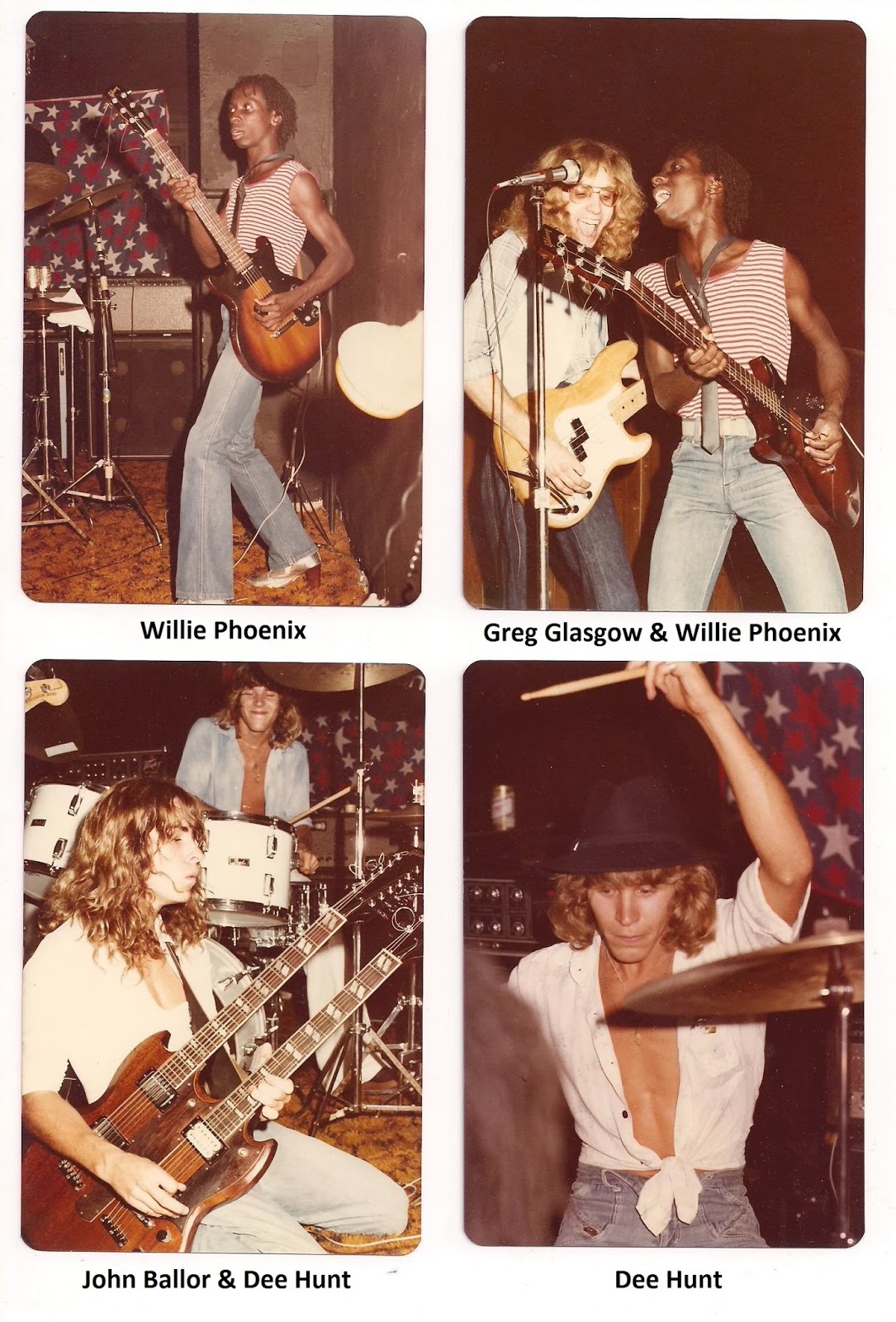
Romantic Noise / early Buttons – Willie Phoenix, vocals & rhythm guitar / Greg Glasgow, vocals & bass / John Ballor, vocals & lead guitar / Dee Hunt, drums (replaced by Jerry Hanahan in the later line-up of The Buttons, somewhere around spring or summer 1979).  


SONGS OF ROMANTIC NOISE AND THE BUTTONS

A rock & roll band rises or falls on its songs.  You can solo all night, but you’ve got to have a song to hang that solo on.  You can have all the special effects in the world, but they have to connect to a song.  If you don’t have the material, if you don’t have the SONGS, sooner or later you’re gonna lose.  The Buttons have songs. Some of those songs are:

CELEBRATE THE GOOD TIMES – Not the band’s theme song, but maybe it should be, somehow it sums up their whole stance and/or attitude. Pinpoint harmony from Willie & Greg, and a bright, positive, clear-eyed, hummable, boppable melody. “Call all your friends, celebrate the good times, ahhhh.”

HOLLY – John’s only current lead vocal. Instant hit single and big crowd-pleaser. Petitions to reinstate John’s other great lead vocal in "I Feel New" will be circulated shortly. “Holly, I love you to pieces.”

DAMN GOOD LOOKIN’ BUT EASY, PAINTER, THE EARLY SIXTIES, I WANT TONIGHT, GET BACK TO YOUR LOVE, NO EXITS, LET’S BE FOREVER, SHELLEY, I FELL IN LOVE WITH A BABY, ARTWORK, CRUISIN’ WITH MIMI, STOP CRUSHING MY PERSONALITY – Some of the Romantic Noise Classics. Songs that may never be recorded because they’ll be old to the band when the band is new to a wider audience. Songs that whenever somebody who saw the band in its early days hears them will trigger off memories of places the band played, people you knew then that you don’t know now, things you were sure of that you're not any more, etc. Some of these songs may only stand in the hearts and minds and ears of a few people, but they ARE magic and they WILL stand. 

STRIKE UP THE BAND – Another Romantic Noise classic that will stand. This is great rock & roll. If you can’t feel the rock in this song you must be dead and should be lying down or else you like Styx. And hey, while we’re at it, in the middle section of this song, feel free, in fact feel compelled, to shout, “GO, GO, GO BAND GO!” along with or AT the band. Get into it, feel it. Come out and be pop, come out to rock. And let’s face it, people are gonna pay $8.50 someday to shout it at an arena concert, you only paid two bucks and you get to see the band up close.

ROCKAWAY, I WANT FUN – Two of the best examples of The Buttons blend of pop and rock & roll power; the latter detailing getting roughed up at a certain popular Ohio State Campus country-rock club, the former concerning  wanting to hold someone’s hand and rocking the days away. “Greg, are you paranoid?” “Naaah.”

THE WORST SAD – What I consider one of Willie’s most underrated songs. Instantly relatable. “I’m sad, she’s sad, this is the worst sad we’ve ever had.” Who could say it any better, or simpler? Why make it any more complicated? Could be THE “Please take me back.” song of the late 70’s.

GOODBYE GOODBYE, SAILBOATS – The Buttons two best slow dance songs. "Sailboats" is a beautiful melody/riff married to great lyrics and "Goodbye Goodbye" has one of those great ending choruses that can go on forever and ever, even if the relationship it’s about didn’t, and just like you always wanted it to. “We tried, we tried, goodbye, goodbye.”

GIVE IT UP, PRETTY JANE, RUNNIN’ FROM SOCIETY, RADIO MAN, POP BAND POP BAND, LOOKING FOR GIRLS, FLY ME, SPOIL IT, UNDERSTAND ME – A selection of the middle-period classics, late Romantic Noise, pre-Buttons hits.

SITTING WITH THE BOYS, HOLD ON, LIKE I DO, I CAN’T STAND IT, OH NO NOT AGAIN – Some of the more pronounced Beatles-influenced Buttons songs. The pop edge of The Buttons power and pop equation.

YOU MADE ME SPEND THE NIGHT, I’M LEAVING, HOLD ME, BUS DRIVER, I NEED THE ACTION, COLD LOVE AFFAIR, CAN’T STOP THE RAIN, MESSAGE, POP GOES THE MUSIC – Some of the genuine Buttons Classics, the power end of the power-pop equation. New songs that have been introduced since the name change of early ’79. Songs that may be too powerful for the close confines of Mr. Brown’s Descent, but you should’ve heard ‘em in the gym at Buckeye Lake’s Sheridan High School (with 250 kids dancin’ and feelin’ GOOD) or at the Ohio Union Ballroom (where they power-popped buzz-bombed fans of The Boyzz), or at The Agora opening for The Ramones. Songs made for big stages, concert halls and huge crowds of crazed rockers.

LOVE IS MADE FOR THE KIDS – The Bee Gees meets The Raspberries. A disco-tinged pop-rocker that I haven’t heard lately, but it may return to the repertoire. Somebody (but not me) will someday call it The Buttons take on Blondie’s "Heart Of Glass."

BIG STAR, IT’S ONLY GOOD ROCK & ROLL, CHINA, SUMMER IS FREEZING, DON’T EVER SAY BYE – The brace of new songs that will be introduced at this weekend’s stand of shows at Mr. Brown’s. Decide for yourself where they fit in. Decide for yourself and let’s ROCK.


Great Lost Romantic Noise/Buttons Songs

(These are songs sadly, or not so sadly, missed from the current band repertoire. Songs that we knew and loved, or hated, when Romantic Noise WAS a romantic noise and buttons were something that held your shirt or blouse closed.)

I FEEL NEW – An exquisite slow, yearning, Byrds-esque tune sung by John from the early and middle period Romantic Noise days. Last heard (by me) at Bogart’s in Cincinnati. Very sadly missed.

I NEED A REVIEW –  A song from the early days of Romantic Noise. Willie’s personal appeal to the Columbus rock print media, Focus and Teenage Rampage, for some coverage. The entire reason I went to see the band the first time in February of ’78, because I wanted to hear my name in a song. It worked.

STARS AFTER DEATH -  Another early song, concerning (I think) a girl who only falls in love with rock stars after they’re already dead, the Jimi Hendrix/Jim Morrison/Brian Jones Syndrome.

GENERATE MY GENERATION – An excellent high-energy rocker from the early days.

STOP CRUSHING MY PERSONALITY -  Another high-energy blast. Winner of the Rock Song Title Of The Year Award for 1978.

BOOGIE ALL NIGHT – Romantic Noise’s set-ender the first time I ever saw them. This song was awful. Really, really badly awful. I mean bad, really bad. How bad was it? This song was so bad that once when they were playing it I saw a dog chasing a cat and they were both walking.  (author’s note; I think the dog & cat quote was some kind of band in-joke that I can’t quite remember.) (blogger's note 2013, I remembered the joke! It was one of Dee’s: “Man, it was hot out today.”  “How hot was it?” “It was so hot I saw a dog chasing a cat and they were both walking.”)

DEAD FLOWERS – The b-side of the band’s first single, "I Fell In Love With A Baby." Another not-very-missed song that was partially redeemed and revived in it’s later performances when John & Willie would meet at the center mike to do their best “Mick Jagger & Keith Richards Meets The Bowery Boys” vocal routine on the closing “Dead flower-a’s.”

ROSE-COLORED GLASSES – Beatle-esque tune recorded in ‘78 for an e.p. that never came out, never performed live to my knowledge.

MEMORIES – A beautifully soft song of Greg’s dropped after only a few performances, another very sadly missed song. “But in my mind it’s still ’73.”

ARE YOU IN LOVE? – An extended, different moods/tempos/accents song of Willie’s that I’m not sure is dropped from the set, I think it might just be on vacation.

(Actually these are only the first ten songs that popped into my head when I sat down to write this; by the time The Buttons record their first LP, they’ll have dropped more good songs than other bands have thought about writing. These songs will be missed, but they will be remembered.) - Ricki C. April, 1979


By my count, there are 59 songs listed above, and that piece only covered the time period from February 1978 to mid-1979, a period of perhaps 18 months. By the time Jerry Hanahan replaced Dee Hunt in The Buttons Mark II, Willie scrapped the entire old repertoire and started over. Below is the set-list from the live tape I have of The Buttons at the Columbus Agora in early 1980.  It contains 18 original songs, none of which are represented above. (The encore - "Hippy Hippy Shake" - is a cover of British Invasion-era band The Swinging Blue Jeans, and is, incidentally, the first & only cover I ever saw Romantic Noise or The Buttons perform.)  That's 77 songs in a two-year period.  I find it hard to believe how prolific a songwriter Willie Phoenix was in those days and how generally high the quality of those songs was.  Very, very few of the songs detailed in this list were what I would deem throwaways and at least 20 of them were as good as any power-pop song I have ever heard.  Willie Phoenix has forgotten more great songs than most other songwriters will compose in their entire careers.


The Buttons / Live @ The Agora, 1980

1) I Wanna Have A Baby
2) (Take It) All The Way Out
3) Fan Club
4) Back To Germany
5) Girl, I Wanna Please You
6) Knockout Girl
7) Baby
8) Now I’m So Glad
9) Alice Jayne
10) Hey Little Girl
11) Rona, I Forget
12) Just A Holiday
13) It’s A Heartbeat
14) Kissing Games
15) Mimi’s Got A Runner
16) Here Comes The Night
17) I Saw Superman
18) Born To Dance
(encore)
19) Hippy Hippy Shake

Willie Phoenix, vocals & guitar / Greg Glasgow, bass & vocals
John Ballor, lead guitar & vocals / Jerry Hanahan, drums


My set-list, for running lights at a Buttons show at the Columbus Agora, March 1st, 1979. 

(The list of colors across the top are the lights I had available.)


© 1979, 2013 Ricki C.


Tuesday, December 3, 2013

The Ballad of Willie Phoenix, part one - Romantic Noise and The Buttons, 1978-1980

I have a heroically garbled cassette tape from 1978 of Romantic Noise, Willie Phoenix's best band EVER, playing a song called "I Feel New."  John Ballor, the lead guitarist of Romantic Noise, sings lead on the tune and it is, quite simply, one of the most gorgeous, heartfelt tunes I have ever heard in my rock & roll life. 

Romantic Noise was stunning.  Willie wrote virtually all of the songs, played strictly rhythm guitar (he didn't start playing lead guitar until The Shadowlords in 1983) and sang about 65% of lead vocals.  Bass player extraordinaire Greg Glasgow contributed the remainder of the original tunes (of which there was a mind-boggling number & variety, which we may deal with in a later appendix) and sang lead on about a third of the Romantic Noise repertoire.  Lead guitarist John Ballor only sang about three leads - the aforementioned "I Feel New,"  "Holly," and an early raver maybe called "Politician, Politician" - but Willie generously handed him off some truly killer songs to sing.  When original drummer David Machnicki (who employed a rather Ringo Starr-inspired style of playing) was replaced by madman Keith Moon-styled smasher Dee Hunt - the pride of Beckley, West Virginia - the Romantic Noise line-up was complete.  (And Dee was height-compatible to fit in with the rather diminutive Small Faces-styled Romantic Noise than the too-tall Machniki.)

For the purposes of full disclosure, I was a roadie for Romantic Noise from probably May or June of 1978 until sometime in 1979 (after they had become The Buttons), so I'm hardly unbiased.  I was a roadie for Romantic Noise because I fell in love with them the very first night I saw them, a week after The Great Blizzard Of 1978, at Drake Union on the Ohio State University campus.  I was a roadie for Romantic Noise because I realized very early on that I wasn't good enough to actually get INTO the band, that the internal cohesion between those four players was so balanced, precise, fragile and perfect that I had no hope of entering the circle.  I ran lights for that band, I took care of guitars, I published a band newsletter, I did pretty much anything that was asked of me.  Willie said, "Jump" and I asked, "How high?"  I was a roadie for Romantic Noise because they were one of the five best bands I had ever seen. 

In my Columbus rock & roll existence I have witnessed The Dantes, The Rebounds, The Fifth Order, The Four O’Clock Balloon, The Grayps and countless other "garage" and "progressive" bands of the 1960’s; I saw The Godz rockin’ the bikers and the hippies in 1975 with their white Marshall amps and McGuffey Lane drawl out their laid-back country-rock pickings that same year; I caught the R.C. Mob and The Toll in their 1980’s formative years right up through their major label deals; in the 1990’s I watched Watershed and Howlin’ Maggie grow up right in front of my eyes into killer rock & roll assemblages; in the 2000’s I got in on the ground floor of Mrs. Children as they transmuted into The Whiles.  And let me say this very clearly: not one of those bands was as good as Romantic Noise. Romantic Noise was, quite simply, the BEST COLUMBUS BAND I have ever seen.

I learned so much from Willie that first year: watching Romantic Noise from the wings or from the balcony lighting board at The Agora was like a songwriting clinic.  I learned to sharpen my rather expansive songwriting down to a succinct precision.  I learned how to pace sets.  I learned a sense of personal style.  (Willie would actually dress the entire band for big shows, like when they would open for The Ramones or the David Johansen Group.  Greg, John & Dee had to bring changes of clothes in for Willie's approval and he would mix & match the outfits so they looked individually AND collectively great.  Every time in 2013 I witness some jag-off modern rock band on David Letterman or Austin City Limits in some hideously mismatched & pedestrian bag o' rags I think back on Willie and the range of his imagination in 1978.)


Willie Phoenix sidelight interlude, number one:
 One summer evening in 1978 my lead singer Nicole and I had to meet Willie at that Wendy’s just north of Schoolkid’s Records (now Used Kids Records) to get some tapes. So we were hangin’ out waiting because Willie was a rock star and rock stardom requires being late. Finally Willie waltzes into Wendy’s. You’ve gotta try to get the mental picture: Willie’s a five-foot tall black man with dreadlocks wearing girl’s pegged black jeans, a spangled tank-top, and not one but TWO neckties tied around his bare neck, held together by a Mickey Mouse watch. Plus, it almost goes without saying, platform boots. AND THIS WASN’T EVEN FOR A SHOW OR A NIGHT OUT, IT WAS JUST WHAT HE HAPPENED TO BE WEARING THAT EVENING. Ladies & gentlemen, it was 1978 in Columbus, Ohio: everybody else in that restaurant was wearing bell-bottom jeans and raggedy t-shirts.  Kinda needless to mention, but the guy turned heads. I can still see it, 35 years later.


1978 FLEW by.  Romantic Noise played all over Columbus and the rest of Ohio.  (They had already traveled to New York City a couple of times and played CBGB's  in the 70's heyday of that fabled rock mecca before I even met them.)  The band played everywhere: clubs, student unions, outdoor shows at a little stage on the riverfront by where COSI now stands, high schools (playing all original material at high schools in 1978 was unheard of - no pun intended - and every one of those shows went GREAT).  They headlined their own shows at Mr. Brown's Descent, Cafe Rock & Roll, Bogart's in Cincinnati and The Columbus Agora, where they also opened shows for the likes of The Ramones and David Johansen Group.

The band released a 7-inch single ("I Fell In Love With A Baby" b/w "Dead Flowers") and a 4-song ep - '78 Affair - that comprised two of their best songs ("Painter" and "Runnin' from Society") and simultaneously two of their worst songs ("Oh No, Not Again" and "Hold On").  This kind of breakdown in song selection on records would unfortunately continue throughout Willie's career.  NONE of Romantic Noise's best material ever got recorded in any kind of intelligible, releasable form.  (Rumors have persisted for years that Willie has well-produced versions of that material stashed away, but I've never seen nor heard concrete proof of that fact.  And what are we waiting for?)

Similarly, two of Willie's best songs from the 1982 period when he was on A&M Records - "Champaign" and "Bowery Express" - never saw wax.  (Though that may have more to do with A&M's total mishandling of Willie's entire stint on the label than it does Willie's judgements of his material.  But more on that in part two of this tome.)   I also have a 60-minute live cassette of The Buttons (Willie's band immediately after Romantic Noise) at a Q-FM Hometown Album concert in 1980 and cassettes full of unreleased Shadowlords songs, most of which are better than anything actually released by those bands on vinyl back in the day.  Further, the three best songs in the repertoire of Willie Phoenix & The True Soul Rockers in 1990 - "Lookin' For Wendy," "I Wanna Feel What We Used To," and "Electric Folk-Dreamin' Man" - never saw the light of day.  And except for the A&M record, Willie had the final say on what material was released in his name.

It was that inability to relinquish even the most basic of control that characterizes Willie to this day.  And while I'll defend to the death Willie's defense of his artistic vision I gotta add that it would've been nice if he could occasionally have collaborated with his bandmates or producers to execute that creative vision.  The first manifestation of that singularity was when Willie announced to the rest of Romantic Noise in November or December of 1978 that come January of 1979, the band would be changing their name to The Buttons (a really pedestrian moniker after the vastly more poetic & lyrical Romantic Noise) and that Willie would be taking over all the lead vocals of said band.

In the heady days of The Summer Of 1978, my most fervent hope was that Romantic Noise would get signed to a record deal and that Nick Lowe would produce their first album.  (Lowe's production work on those first two Elvis Costello records - My Aim Is True and This Year's Model - and his production credo of "Bash it down and we'll tart it up later." would have been PERFECT for Willie & the guys.)  By the spring of 1979 Dee Hunt had been booted from the band, ostensibly over the cliched "musical differences," but actually he was the only band member who would ever talk back to Willie and (this is my purely subjective opinion) Dee's increasing popularity with the female contingent of The Buttons' audience became problematic to Willie.  I quit the road crew when Dee was replaced with Jerry Hanahan, a really good drummer in his own right.

The Buttons subsequently played a lot of really great shows - the aforementioned Q-FM Hometown Album Concert and a KILLER set opening for Talking Heads at Mershon Auditorium right when the Heads' cover of Al Green's "Take Me To The River" was starting to burn up the charts - but the band was never really the same for me after Dee got fired, ya know?  The Buttons Mark II (or Version 2.0 for you 2013 cyber-geeks) with Hanahan on drums released one single, which, true to form, contained one GREAT song - "Hey Little Girl," that stayed in Willie's repertoire until the 1990's - and one middling tune - "Blue Bicycle," which of course Willie regarded as the A-side of the 45.  (The Buttons most popular radio song - "I Saw Superman" - was recorded when Hunt was still in the band.)

Okay, so that's 1700 words already and we're only up to 1980.  Coming up in The Ballad Of Willie Phoenix part two we'll be covering the A&M "Big Band" and Willie Phoenix & The Shadowlords (with maybe The Flower Machine thrown in for good measure).  But first, some Romantic Noise pics, a Focus live review and a scan of a Buttons Times.


Romantic Noise, 1978


(Did I remember to mention to the editors at Focus that I was working as a roadie for the band I was
 reviewing in this column?  Ummm, that particular conflict of interest might have slipped my mind.)


(For three random Willie stories from 1978, check out When We Was Kids, published 2020.)


© 2013 Ricki C.
   

Saturday, November 30, 2013

Teenage Rampage and Back Door Man, Fanzines in the 1970's

My 1970's fanzine - Teenage Rampage - grew wholly out of the inspiration of Back Door Man, to me rock & roll fandom's most perfect creation ever.  In 1976 I was working 40 hours a week in the warehouse of a Service Merchandise catalog showroom.  I likely had a rock & roll band going - most likely at that point it would have been The Survivors, before my band The Strokes formed in 1977, a year before Julian Casablancas was born - but probably not a very good one.

The highlight of my rock & roll existence in 1976 was when my issue of Back Door Man - the pride of the South Bay area of Los Angeles, California - would arrive in my mailbox.  (I get the feeling South Bay was the L.A. equivalent of the West Side of Columbus, Ohio.  Blue collar working-class and damn proud of it.  Aerosmith over The Mahavishnu Orchestra any day.)  Back Door Man was my only connection to quality rock & roll.  There were times that year I might as well have been speaking Swahili to the rock illiterati I interacted with, as little communication as we shared.  Those people wanted to listen to Black Sabbath and The Allman Brothers Band, I wanted to listen to The Dictators and The Modern Lovers.  The Back Door Man staff and I understood one another implicitly.  I would take my Service Merchandise lunch hour in a quiet little outdoor area of our shopping center and DEVOUR the latest issue of the mag.  Phast Phreddie Patterson, D.D. Faye, Don & Liz Underwood, Lisa Fancher and especially Don "Doc Savage" Waller were my long-distance friends that, as it turned out, I would never meet.  They were my confidantes, my role models, my inspirations.

I would write them long, ridiculously impassioned letters about rock & roll and they always answered me.  It was my equivalent of the relationship between the Cameron Crowe character and Lester Bangs in Almost Famous, which, by the way, is, in my humble opinion, far & away the best movie EVER made about rock & roll. 

Teenage Rampage was born when the Service Merchandise store copy machine was moved from the front office to the warehouse because we had to make so many more copies: of purchase orders, bills of lading, packing slips, etc.  At some point we realized there was a way to turn the counter of the copier back one entire digit, i.e. we could make 300 copies but only 30 showed up on the counter.  Voila, I had a publishing empire.  (I can't tell you how many times our store manager of the time would comment, when he visited the warehouse to make front-office copies, "I can't understand how we're constantly out of copy paper when we're only making 100 copies."  My good friend to this day Rob and I would shrug our shoulders and make some non-committal comment.)

I'd type up the issues at home on the trusty Royal typewriter that my sainted Italian father (see blog entry Birthday Blog, June 30th, 2013) had brought home for me in the 1960's, when I developed an interest in typing, from the Columbia Gas Of Ohio warehouse where he worked.  (Is there ANY aspect of the creation of Teenage Rampage that does not include petty theft of office materials?)  I'd post a lookout outside the warehouse office and run off maybe a hundred copies at a time.  (Said lookout failed miserably at his job at least once during production of the mag when the store manager walked in on me while I had about 100 pages of issue two spread out all over the copy area.  I just threw some purchase order copies over the top of them and tried to gather them up as calmly and innocently as I could.  By luck, nothing came of it.  I could have gotten fired for that infraction and I needed that job.)

Teenage Rampage was named after The Sweet song of the same name - a song I had never actually heard at that time, English import that it was, but had read about in the pages of Bomp! magazine, Greg Shaw's vitally important & influential publication of the time.  Bomp! was my mid-1970's post-Creem, pre-New York Rocker - rock & roll Bible.  It was Greg Shaw who put me in touch with the guys & girls from Back Door Man, as well as with Nancy Foster from the North Carolina 'zine New Age, who later provided me with some journalism & poetry for issue five of Teenage Rampage.  Greg Shaw really was one of the great early movers & shakers of the punk & New Wave scenes in America, and his inspiration & passion have gone largely unheralded & unsung.  I miss his writing to this day.  It's hard to convey in this time of smartphones, instagram & twitter, but in the mid-1970's the only way small pockets of rockers all over the United States had to communicate with, or indeed, to find one another was by writing letters or exchanging fanzines.  It was a different - and in some ways - a better and more innocent world back then.

The first couple of issues were double-sided broadsheets, 8-1/2 x 14 inches, stapled together back to back.  (With Service Merchandise staples, naturally.)  By issue three, after the close call with Management and by which time I actually had some subscribers and money coming in, we went to five-page 8-1/2 x 11 inch issues that I ran off at a local copy store that would cut me a break.  (Issue five was a whopping 10 pages.)

I had colleagues and associates on the paper, Allan Tinney and Cliff Phillips should be mentioned in particular, and guest writers like the aforementioned Nancy Foster and Lisa Baumgardner from Kent, Ohio, whom I first made the acquaintance of when I sent away for a Pere Ubu single in the mail.  (No Spotify, Dropbox or Rhapsody back in the day, you just sent away for 45's, and your friendly postman brought 'em to your door.)

Issues were distributed free all over the West Side wherever Focus magazine (the bane of my existence, the "official" Columbus rock weekly, which I saw as little more than an excuse for stereo store, car audio, apartment complex & campus bar ads, with a few "rock" stories thrown in) was available.  Teenage Rampage's motto was "We're freer than Focus," which I found very clever, if I do say so myself.  On Saturdays I would take the bus to campus (I didn't have a driver's license until 1978 when I was 25, but that's a whole other story for whole other blog) and leave issues at all the record stores there.  I'm not sure why, but I always left the mags very surreptitiously, I didn't want anybody to know I was connected with the fanzine.  There was just something about the anonymity that I liked.  I wanted the focus (pun intended) to be on the writing and the music, not personality. 

That anonymity led to my favorite story about the fanzine.  One day I was trolling the used-vinyl bins in Mole's Records, the almost insufferably hip record store above Bernie's Bagels.  The three too-cool-for-school employees were reading the latest issue of Teenage Rampage and arguing over the auteurs of said issue.  "It's gotta be Zero Watts from The Blades putting this out," one opined.  "No, it's that kid with the mohawk & leather jacket that's always yelling at hippies on the lines at McGuffey Lane shows at Zachariah's," stated The Captain, the bespectacled owner of the store.  As I stood there in my denim jacket, with my mustache & my long hair, I found myself thinking, "This must be exactly what it feels like to be invisible."

Those three people argued about the fanzine I created and edited for the entire 40 minutes I was in the store, and never took one moment's notice when they rang up my purchase, a used copy of "Pure Pop For Now People" by Nick Lowe that I bought for a buck, that I still pull out and listen to right up until today.


This is a small sampling of some pages from Teenage Rampage, issues five and six.  Issues two, three & four have been lost to the sands of time and rock & roll.  (Oddly, the only article in those three issues I have any clear memory of was one entitled "Disco-Shit and the Loss Of Virginity," that was largely concerned with and detailed the nocturnal expeditions of some of my female Service Merchandise co-workers to the local West Side disco - The Dixie Electric Company - and the truly sad & disheartening sexual encounters that grew out of those excursions.)  (And that article ran two full years before Saturday Night Fever was released to theaters.)

I produced the final issue of the 'zine completely on my own in late January, the weekend after The Great Blizzard Of 1978, while snowed in at my Lincoln Park West apartment.   All along it had partly served as a way to find musicians for - and later to promote - the bands I had going at the time: The Survivors, The Strokes (decades before Julian Casablancas & company, a band I loved 2001-2003), Ricki & The West Side Rockers, New Action Ltd. and finally, The Twilight Kids, whose exploits are detailed in I Love Distortion.  Ultimately - in an admittedly sleeping with the enemy move - when Focus changed editors to an enormously charming, erudite & musically savvy young woman named Kathy Reed, I wound up writing for them, realizing I could reach thousands more people in a weekly magazine with huge circulation than I could with a xeroxed fanzine.  As I've said many times in this blog, I wanted to be a rock & roll star, not a punk legend.

Looking back, I always thought of Teenage Rampage as a punk fanzine, but really it was more of a hard-rock or just plain rock & roll publication.  As much as I loved The Patti Smith Group, The Clash and Elvis Costello & the Attractions, I was certainly much more interested in Blue Oyster Cult and Bruce Springsteen & the E Street Band in those years than I was art projects like The Sex Pistols or Talking Heads.  (Let alone jag-off hangers-on like The Weirdos or James White & the Contortions.)

I was just a West Side boy with access to a copy machine, looking for some good rock & roll.  (Much like I am today.)


(special thanks to reader/follower Christopher Stigliano for suggesting today's blog topic)

(for a critique of our little paper by England's New Musical Express back in 1978,
see blog entry, Rock & Roll Regrets, August 11th, 2013)


© 2013 Ricki C.
(Teenage Rampage content © 1976, 1977, 1978)

Monday, November 25, 2013

I Love Distortion (a rock & roll novel in twelve chapters) - November


(I Love Distortion (a rock & roll novel in 12 chapters) appears monthly in
Growing Old With Rock & Roll; January to December, 2013)


I Love Distortion - chapter eleven

"You lead me to believe that you're the type of person
Who believes in full moons and my my ideas, diverse as they are;
The stupid majesty of electric guitars

I'm only funny in the comics / Reality is too tough"
- Nicole Page, 1978


November was the time when all the toy balloons that had kept The Twilight Kids aloft throughout the summer months began to pop, one by one.

We finally had to fire Jake the drummer.  Even more than not being able to meet the stylistic changes of the band (see I Love Distortion - October) he had started to turn up drunk for rehearsals and gigs.  I'm not contending I was any saint - I was certainly still drinking and smoking pot in 1978 - but I had band standards to maintain.  My bands weren't democracies, they were more like benevolent dictatorships.  I'd freely take suggestions from band members (and let's face facts: Nicole certainly had more input than Jake or Jeffrey Jay), but rules were rules.  There was no drinking or drugging at rehearsals and none before gigs.  Jake crossed that line about ten too many times, and he was out.

The same week Jake was cut loose, Billy Ray announced to the other members of Lovely & Sonic and to the road crew (which included me) that, as of January, the band would be changing its name to The Apartments and that he was taking over 100% of the lead vocals.  To that point, Billy Ray wrote 95% of the songs in Lovely & Sonic, but doled out lead vocal assignments to bass player Glen - who contributed the other 5% of originals, and sang maybe 30% of leads, with John the guitarist at about 10%.  Billy Ray sang the other two-thirds. 

Admittedly, The Great Lead Vocal Power-Grab made some musical sense.  The Sixties were certainly long-gone & over, and the idea of having one recognizable lead vocalist  held some commercial sway, but it also made Lovely & Sonic - who wore their lead-vocal diversity like a Badge Of Honor - impossibly more one-dimensional.  And by any standard, The Apartments was a pedestrian band name after the more lyrical Lovely & Sonic.      

"You were gonna be Carlene Carter
I was gonna be Nick Lowe
We reinvented ourselves
Our lives were gonna be the show"
- Sean Richter, 1990

At the same time we were scouting for a new drummer, the close-harmony country music family band that Nicole sang in with her parents and younger sister (see I Love Distortion - February) had a Thanksgiving weekend show scheduled  at the Southern Theater in downtown Columbus.  WMNI - Columbus' country station from the late 1950's through the 80's - broadcast from the penthouse of The Southern Hotel and the theater was situated just off the lobby.  The Southern Theater was renovated and restored to first-class venue status in 1998, but when Nicole and her family were booked there - opening for some long-forgotten mid-level nationally-known country act - it was a sadly dilapidated dump.  There were rats in the backstage hallways.  Nicole's dad and his bass player swear they killed one in the dressing room with some drum hardware, and I believed them.  Nicole, her mom and her sister changed into their stage outfits in the women's restroom in the lobby.  (It's very possible we played the last show in that theater before it was closed down by the city.)

The Thursday before the Saturday night gig, Nicole's dad's lead guitarist broke his hand during an altercation at The Little Nashville Club, a West Side country-music dive.  I guess I was a natural emergency substitute in the situation, but I certainly wasn't a natural fit with country music.  Willie Nelson was possibly the only country artist I had ever listened to.  Even Johnny Cash wasn't a contender in those long-ago 1970's pre-Rick Rubin resurgence days.

And Nicole's dad - Roger, by name - wasn't overly inclined to welcome the long-haired, rock & roll-playing, seven-years-older-than-his-daughter, married/fooling around guitarist into his rather sedate middle-aged combo, even for one night.  But he was in a bind, so I was in.  Roger and I got together an hour before the rest of the band convened on Friday night for the only rehearsal we would have before the show.  I had to learn an entire set of material in one night.  When I expressed my trepidation about that notion and about not being a country player, Roger said, "Well hell boy, it's country music.  It's just G to D, and D to G, and if you get lost, go to C and wait."  (Twelve years later, in 1990, I was stoned in my living room watching a Cleveland Browns game and used those three chords to write a country song about all of this stuff entitled "Are You Still Singing."  It still occasionally turns up in my live sets to this day.)

It turned our Roger and I bonded almost instantly over a shared love of Buddy Holly.  When we first pulled out our guitars to see if this musical pairing was even worth bothering with, I think we banged out seven Holly tunes in a row, while Nicole and her sister Beth stood in a corner, nervous smiles of relief on their faces.  Roger was taking little pulls off a glass of Jack Daniels that Nicole's mom, Jane, kept filled all through the hour as she bustled in and out of the basement rehearsal room.  I had met Jane only one time previously, months earlier, when she visited Nicole one day in the toy department at K-Mart and Nicole introduced us.  As I smiled and shook her hand that day it took her one long moment to place who I was - her engaged daughter's guitar-slinging married boyfriend.  She gave me a good long once-over, shook her head, looked at Nicole and said, "Oh, he is trouble, isn't he?"        

In that basement rehearsal room, over the next three hours we cobbled together a 45-minute set we could play the next night: songs that were standard to The Page Family set - Willie's "Mama, Don't Let Your Babies Grow Up to Be Cowboys," Cash's "Ring Of Fire" (a killer duet rendition between Nicole's mom & dad) and Merle Haggard's "White Line Fever," a song I actually already knew from an old Flying Burritto Brothers album I'd been listening to since 1971.  Beth & Nicole put together a stunning a capella version of Carlene Carter's "Appalachian Eyes" that Roger had learned by ear and memorized after hearing it once at a Johnny Cash/Carter Family Revue show at the Ohio State Fair the previous summer.  It was beautiful, gorgeous, and effortless by Beth & Nicole, easily the high-point and centerpiece of the set.        

We also worked up a set-ending cover of Buddy Holly's "Not Fade Away" that Roger and I had had a ball playing before the band got there.  It was the only song of the set that kicked off with my guitar leading the way, and every time I started the song, Roger's drummer would just say, "It's just too damn fast, hoss," and refuse to come in on the backbeat.  After years of playing rock & roll and then shading into punk I just COULD NOT adjust myself to the rather somnambulistic country tempos.  At one point, even as I tried to slow down to the drummer's standards, he just simply put his sticks down on the snare and walked out of the basement rehearsal room.  Roger said, "You've got to slow it down, son, we can't afford to lose the drummer, too."  I looked at Nicole.  She said simply, "Slow it down, Sean.  For me."  And I was done.  (I got the drummer back, though, at the actual show by kicking the song off even faster than I had at rehearsal because I could tell he was too much of a professional to walk off the stage in the middle of the show, and I was right.  Man, we BLAZED through that tune.  He could barely keep up.)

"It's right and it's good
It's wrong and it's bad
But times are happier now
Than other times I've had"
- Nicole Page, 1978

Midway through the show I was standing in the wings watching Nicole and her little sister Beth doing their solo/duet star-turn on "Appalachian Eyes."  It was a song I wouldn't hear again for two years, when it was released on Carlene Carter's Musical Shapes record.  It was November 25th, 1978.  It was Nicole's 19th birthday.  It was the last time I would ever hear Nicole sing.

I was lost in the beauty of the harmonies, in the sheer crystalline shimmer of those voices intertwining, and in the sight of Nicole & Beth in the stage lights when Nicole's mom put her hand on my shoulder and said quietly, "Don't look at her that way, son."  "Oh, no, no, no, ma'am, it isn't like that," I stammered out, thinking that Nicole's mom thought I was looking merely lustfully upon her daughter, "I just love her so much."  "I know you do, son, I know you do," she replied, touching my cheek, turning my eyes to hers, away from the stage, "I'm just not sure you should."  

But I didn't hear what she said.  I was deaf as a Deadhead.  I didn't know it yet, but I was hanging by a thread.


© 2013 Ricki C.

Friday, November 22, 2013

Lou Reed "The Day John Kennedy Died" (Bonus Video Friday)

I was 11 years old, in sixth grade at St. Aloysius grade school in Columbus, Ohio, on November 22nd, 1963.  We got the news about President John F. Kennedy being assassinated over the school PA system from the principal, a priest whose name I don't recall.  I remember the nun who taught sixth grade, whose name I also do not recall, crying at the news.  She didn't sob uncontrollably, I think she tried to keep it together for our sake, but she cried for a long time as she asked us to sit silently and pray for our first Catholic president, dead now in a hospital in Dallas, Texas.

There are things in this life that I know and things that I do not know.  I know that Lee Harvey Oswald did not act alone in shooting President John F. Kennedy.  He just wasn't that good a marksman.  I do not know whether it was government officials or members of organized crime or just American corporate bosses who commissioned the shooting but I know that it was one - or some combination - of those three.  I used to wonder whether I would find out which organization was responsible in my lifetime.  I really don't wonder about that much anymore.  I don't have that much time left to wonder.  It's been 50 years today: either somebody's REALLY good at keeping secrets, or I'm just a Catholic boy, thinking about this all wrong, and first Lee Harvey Oswald, and then Jack Ruby, just got off a couple of incredibly lucky shots.

Either way, I got cheated out of a future with two terms of President John F. Kennedy and no President Richard M. Nixon. 

But then, would I have gotten The Beatles, and The Who, and The Velvet Underground?

There are things in this life that I know and things I do not know.


inspirational verse; "I dreamed I was the President of these United States /
I dreamed I replaced ignorance, stupidity and hate /
I dreamed a perfect union, and a perfect law undenied
Most of all I dreamed I forgot the day John Kennedy died." - Lou Reed, 1982 


R.I.P. John & Lou


© 2013 Ricki C.


Wednesday, November 13, 2013

Shows I Saw In The 1960's, part three; The Jimi Hendrix Experience, 3/3/1968 and The Doors, 11/2/1968


This is the third (and final) installment of a series about my favorite 60's concerts.
Part one, Bob Dylan & the Hawks appeared May 3rd, 2012; part two, The Who, December 7, 2012.


The Jimi Hendrix Experience / Veteran's Memorial Auditorium / Sunday, March 3rd, 1968

I know the exact date of this show because sometime in the 2000's an old friend bought me a reproduction of the original poster advertising the show (see below).  It was a show that marked a lot of firsts for me: the first show I attended with Dave Blackburn, my best friend & bandmate who taught me more about music than any other person on the planet (see blog entry The Guitar / The Band / Dave Blackburn, February 12th, 2012) after we discovered our mutual love of The Who junior year of high-school; the first time I ever saw a Marshall amplifier, let alone the fucking WALL of Marshall amplifiers that Hendrix and bass player Noel Redding employed; the first time us Kids From The 60's called a live performance a concert instead of it being a rock & roll show.

Seeing Jimi Hendrix live really was astounding.  It was everything live rock & roll should embody.  First off, it was overpoweringly, scary, great LOUD.   And Hendrix put on a SHOW - playing his white Stratocaster behind his back, with his teeth, humping said Marshall stacks with said Fender - pretty much all the things he did in the Monterey Pop film, only for an hour instead of the few minutes he was in the movie.  He was certainly lewd & lascivious (I'm not sure my little Catholic-boy brain had fully processed exactly what "Let me stand next to your fire" entailed before that night), but simultaneously really FUNNY.  At one point in the show, somehow - by some sonic freak of nature - Hendrix's Wall Of Marshalls starting picking up WCOL-AM, the local Top 40 radio station, while The First Edition's "Just Dropped In To See What Condition My Condition Was In" was playing.  (In retrospect, I don't think I've ever heard Jimi Hendrix and Kenny Rogers in such close proximity ever again in the intervening time.)  Jimi turned the master amp volume WAY up so the audience could hear the Rogers' tune, played along with it for about a minute, said, "Ooooo, psychedelic music," and launched into a blistering take on "Foxy Lady," all without missing a beat.  It was hilarious.  It was classic.  I remember it like it was yesterday, and it was 45 years ago.

I don't remember everything The Experience played.  I think they did the large majority of the first album.  I know they played "Red House," a song I had never heard, the song that Hit Parader magazine informed me had been left off the American version of Are You Experienced.  I know Noel Redding and Mitch Mitchell were truly great and Mitchell was probably the best drummer I had ever witnessed, until the next year, November 1969, when I saw Keith Moon with The Who.  I know it was one of the greatest live shows I ever saw.  I know it was one of the shows that ruined me for much of 1970's lunkhead rock & roll.  How was I supposed to take fucking Bachman-Turner Overdrive or Montrose or REO Speedwagon seriously?  I had seen JIMI HENDRIX play the guitar live. 

I know that whenever I see a clip of Hendrix - however brief - it always brings back that feeling in the pit of my stomach that only 60's rock & roll concerts gave me: when everything was new; when everybody played like their lives depended on it (and for Hendrix, Jim Morrison and Janis Joplin, it turned out they pretty much did); when people played music like you had never heard it, when people stalked stages like you had never seen, when you had your whole life laid out in front of you and everything was going to be fabulous from that night onward.


The Doors / Veteran's Memorial Auditorium / Saturday, November 2nd, 1968

The first time I read Jerry Hopkins & Danny Sugerman's Jim Morrison biography No One Here Gets Out Alive back when it was published in 1980, I came across the following sentence, "The concerts in Milwaukee and Columbus on the 1st and 2nd (of November) were ordinary."  I was at the concert in Columbus on November 2nd.  After police stopped the show during the set-ending "Light My Fire" and ordered the crowd to disperse, the audience refused to leave the auditorium for 45 minutes and subsequently began ripping up & setting fire to the seats in Veteran's Memorial.  I'm not sure what constituted an "ordinary" show to Sugerman in sunny Los Angeles, but in Columbus, Ohio, this was not your everyday rock & roll show.

The Doors opened with "Tell All The People" that wouldn't be released until The Soft Parade album in July of 1969.  That was another great thing about 60's live concerts, there were no rules & regulations.  Bands weren't required to start the show with the first cut off their newest release.  Everything wasn't pre-programmed to match up with the lighting cues or the backing samples.  The band actually played and sang all the instruments and vocals in the songs.  Imagine that in this 21st century of Kanye, Lady Gaga, or even U-2.

The Doors' entire live show teetered on the brink of disaster at almost any and every given moment.  Songs got shortened, songs got wildly elongated; not only did instrumental solos by Ray Manzarek on organ and Robbie Krieger on guitar get improvised, Jim Morrison improvised entire verses & choruses.  I'm not sure there were more than four or five songs where Morrison sang the original lyrics.  And through it all John Densmore sat above, pounding out the beat, keeping it all together.

I'm not sure how to convey to you today in 2013 how simultaneously shambolic and truly transcendent the Doors show was at every turn.  Forget set lists: Densmore would hop off the drum riser and the band would huddle-up by Manzarek's keyboards every three or four songs to hash out (no pun intended) what they were going to play next.  And these weren't polite NFL huddles where the quarterback barks out plays and everybody snaps into formation, this was four guys talking, yelling & gesticulating until the next part of the set took some kind of shape.

Anything could happen.  Jim Morrison would sit down on the edge of the stage and start reciting poetry, sometimes with the mic, sometimes just yelling through his hands.  And then the band would fall in behind him and improvise a tune like they'd rehearsed it dozens of times.  Other times they'd just sit out and watch him recite for as long as the words & muse moved him.  Morrison would dance around like a shaman during the solos, or just simply walk off into the wings and leave the stage to the three instrumentalists.  Ray Manzarek did at least two lead vocals that I can remember.

And let's make one fact abundantly clear: I am a happily-married, heterosexual, working-class Ohio boy, but goddamn, that November night Jim Morrison was the most gorgeous man I have ever seen IN MY LIFE.

I know the band played "Five To One."  They played both "The End" and "When The Music's Over."  They played all of "Celebration Of The Lizard," along with all the pop hits - "People Are Strange," "Love Me Two Times," "Hello, I Love You."  They played "Break On Through," and "Back Door Man."  I can't even picture how long they were onstage, it was a LONG fucking set.  The show in Columbus took place well after the infamous New Haven, Connecticut, show where Morrison got busted onstage for bad-mouthing the cops after they maced him backstage.  By time The Doors crashed into a set-closing "Light My Fire," Columbus policemen had started to gather at the sides of the stage, near the PA speakers.  The entire set had been liberally sprinkled with profanities, let alone just flat-out provocations, you could FEEL the tension in the air.

But when Morrison strolled up to the mic at the end of the "Fire" solos - at the point where Robbie Krieger did the "duh-duh-duh-DUH-uh, duh-duh-duh-DUH-uh" guitar figure - and started YELLING "Fuck, fuck, fuck, Fu-uck, Fuck, fuck, fuck, fu-uck" you could tell all hell was going to break loose.  The cops initially just looked at one another nervously, like they were trying to figure out what they were supposed to do, how this was supposed to be handled.  Finally, after the band had moved into the last verse of the song, someone in authority made the decision to just close the curtains and end the show.  Before they were fully closed though, Morrison & Krieger scooted to the front of the stage, in front of the curtain, and kept singing & playing, with Manzarek & Densmore somewhere behind them, out of sight.

At that point the fire curtain - a weighted, heavily-padded piece of fabric designed to prevent a fire spreading from the stage to the auditorium - was dropped from the ceiling into the orchestra pit, cutting all of The Doors from the audience's view.  But they still kept playing.  Thirty seconds later all the red lights on the PA in the wings of the stage blinked out as power was cut to the speakers.  But John Densmore just kept pounding away, completely out of sight behind the regular and fire curtains.  About a minute later that tribal drumbeat ceased when, I would imagine, someone either took the sticks away from Densmore or toppled him off the drum riser.

This entire time the audience was on its feet, shouting and going nuts at the performance.  The termination of Densmore's beat brought a chorus of boos & derision from the crowd and when a burly cop groped his way out from under the fire curtain and announced to the assembled multitude, "The show's over!  It's over!  You kids go home!" his pronouncement was met with a hail of anything the audience could find to throw - plastic cups, pens, coins, hats, gloves (it was November), etc.  This all went on for almost 45 minutes and I don't think I saw more than 20 or 30 people leave the auditorium.

My dad - who got me into all of those rock shows (see blog entry Birthday Blog, June 30th, 2013) - came to check on Dave and I at one point, but he and his fellow Central Ticket Office employees had their hands full trying to secure the box office from being overrun with pissed-off concert-goers.  I convinced him we were fine and he went back to work.  Two rows up from us, people had started to tear up the Veteran's Memorial seats and set fire to them.  Cops rushed over and put them out, but it was all they could do to keep all the small fires doused.  Light my fire, indeed.  It was pandemonium.

Finally, when it became painfully clear that NOBODY in the chanting, booing, out-of-control crowd was leaving Vet's, and that the outnumbered police in the venue had no chance of clearing the auditorium, the fire curtain was raised, the PA lights winked back on, the stage curtain parted and The Doors blasted back into "Light My Fire" AT THE EXACT SAME NOTE WHERE THEY HAD BEEN FORCED TO STOP THE FIRST TIME!  It was simultaneously the coolest, cleverest and greatest display of rock & roll stagecraft and mayhem I have witnessed in my 61 years on the planet.

Ray Manzarek and Jim Morrison, God bless you wherever you are tonight.


© 2013 Ricki C.


Sunday, November 3, 2013

Of Nuns I Knew in High School, Poetry & Journalism, the New York album, and the President of Czechoslovakia: Further Thoughts On Lou Reed


"I'm a journalist, I ain't no poet
People say, "Ricki, you've got limitations."
I say, "Baby, don't I know it."
- from "I Still Play The Rock & Roll" Ricki C., 2002

I wrote the lyrics quoted above while listening to a cassette tape or a CD (I forget which) by my good friend Don Nelson, who is indeed a poet singer/songwriter.  Don and, by extension, many other singer/songwriters (Elliott Murphy comes immediately to mind, in this case) are poets by nature, and come to music that way.  I'm not saying those people sing poetry.  I know the difference between song lyrics and a poem.  I'm saying they have the hearts of poets and I'm saying - for better or worse - I do not have the heart of a poet, I have the brain of a journalist.

I attended a Catholic high school in Columbus, Ohio, in the 1960's - Bishop Ready, by name.  (It's pronounced "reedy-y," by the way, just like Lou, not "ready," as in, "I'm ready for my close-up, Mr. DeMille.")  My journalism teacher junior & senior years was Sister Ann Mary ("Sam" for short) and along with my junior year English teacher, Sister Paula Clare, they formed the writer I am today.

The reason I ran my initial Lou Reed piece last Monday was because Sam constantly drummed into my impressionable teenage brain, "News is news!  Write it!  You don't always have time to think about it or reflect on it.  Write it!  Write it!  Write it!  It's news!  Get it out there!  You can write an op-ed piece about it later on, when you've had time to rest and consider, but RIGHT NOW it's news!  Write it!"  (I think this is the reason Nick Lowe's production credo for the early Elvis Costello & The Attractions albums - "Bash it down and we'll tart it up later." - appealed to me so strongly, and resonates with me to this day.)

Now that we're into the Sister Paula Clare area of literary rest & reflection period, I can settle down and spread out with some ideas.  (Sister Paula Clare, by the way, gave my best friend Dave Blackburn and I Joseph Heller's "Catch 22,"  J.D. Salinger's "The Catcher In The Rye," and found me a copy of Hubert Selby Jr.'s "Last Exit To Brooklyn" to read after Lou Reed mentioned it in a Velvet Underground interview in Hit Parader magazine, my rock & roll Bible of that time.  And if you think books like those were being routinely handed out by nuns to students in Catholic schools in 1968 you'd best think again, my friend.)

Sister Ann Mary, Sister Paula Clare: thank you for everything you gave to me.

I was listening to Lou's 1990 New York album in the shower this morning and was struck again, as I have been so many times in the past 23 years, at how perfect a blend of poetry and journalism it is.  I remember clueless rock critics at the time putting the record down for its journalistic slant, asking how Reed thought it was possibly going to stand the test of time - as if lyrics like "The perfume burns his eyes / Holding tightly to her thighs / And then something flickered for a minute / And then it vanished and was gone" from lead-off track "Romeo Had Juliette" were ever gonna lose their resonance or relevance and go out of style.  I've read 700-page novels that don't say as much as Lou Reed does in the 3:09 running time of "Romeo Had Juliette."

I acknowledge full Saturday Night Live Weekend Update Drunk Uncle mode here: but Mumford & Sons kids, Arcade Fire kids, Lumineers kids, I would just ask you to go to Rhapsody or Spotify or Dropbox or Pitchfork or wherever Rock Children go for music these days and listen to "Romeo Had Juliette" from New York, "Work" from Songs For Drella, and "Dreamin'" from Magic and Loss, and then tell me everything you know about the power of rock & roll music. 

There was a piece published in 1991's Between Thought And Expression: Selected Lyrics of Lou Reed entitled "To Do the Right Thing" that Reed originally wrote for Musician magazine in 1990.  It was about his visit to Prague and his meeting with Czechoslovakian president Vaclav Havel, who was once jailed as a dissident and later became president of his country.  (Much like Nelson Mandela in South Africa.)  I'm not sure how easy that book or essay would be to find in these 21st century days, but you really should try to track it down, it's simply transcendent poetic journalism.  Find it, and read it, you won't be sorry.

But while you're waiting.......


© 2013 Ricki C.